
Wearable and digital health validation
Clinical reference data for wearable validation, collected in the participant's home.
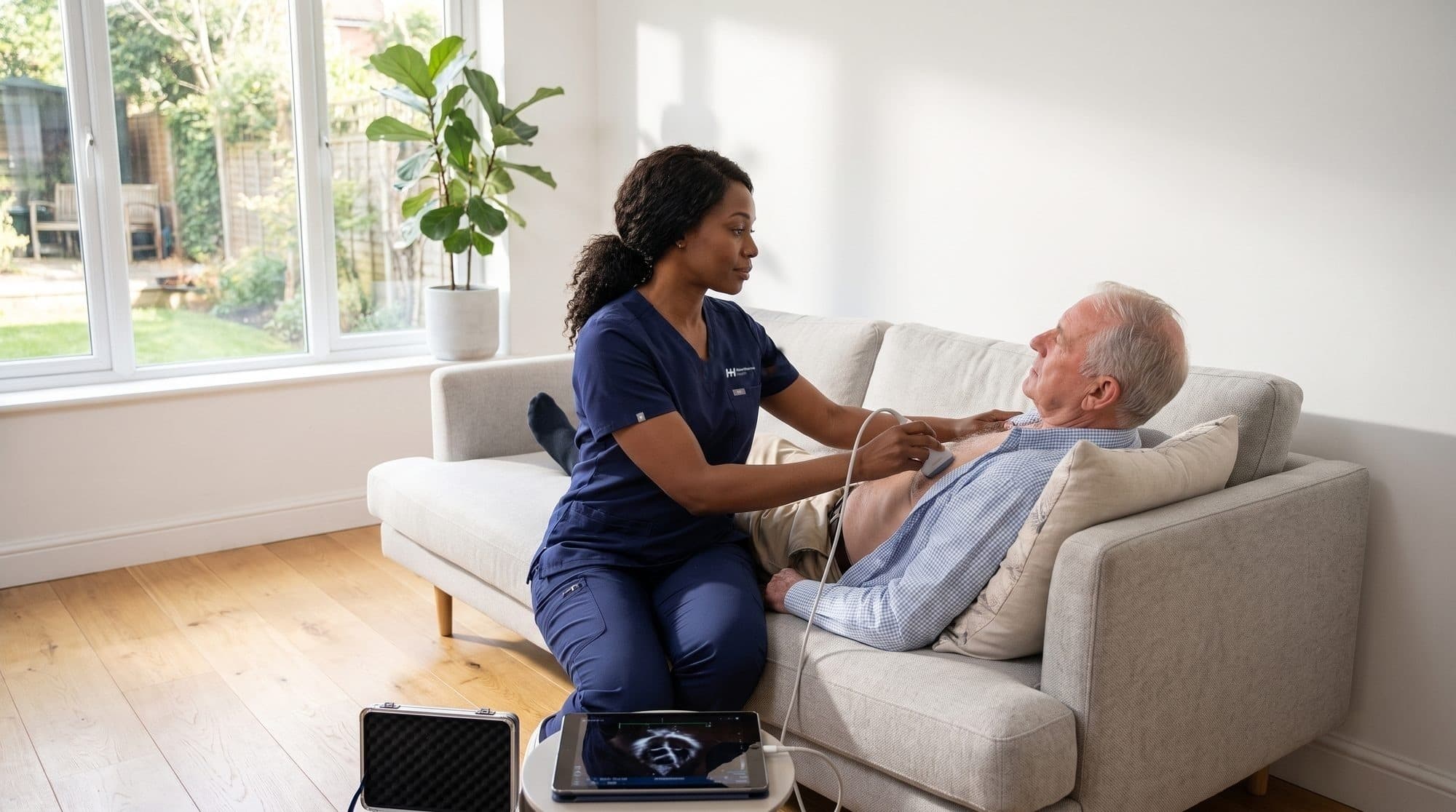
Device data travels with your participants. We bring the reference measures to them as well: echocardiography, vascular ultrasound, fasting samples and vitals, collected at home in all 50 states and read by board-certified cardiologists. One agreement, one project manager and one quality system.

The hard part of a validation study
Device data travels with the participant. The reference measure should too.
Features become clinical claims
Wearables now flag blood pressure, heart rhythm and signs of heart failure. A feature that makes a clinical claim needs validation behind it.
Claims are checked against a reference standard
The feature is compared with what a clinician would measure: an echocardiogram, a vascular ultrasound, a cuff blood pressure or a fasting blood draw.
The reference is the hard part to scale
Reference measures usually mean a clinic visit, which limits who can take part and when. We bring them to the participant’s home inside the wear period.
In one decentralized study, about 1 in 6 participants had a reference echocardiogram.
In a decentralized smartwatch ECG study reported by Mayo Clinic, 2,454 participants sent ECGs from 46 states. About 420 had an echocardiogram within 30 days to compare against, because the echo depended on a clinician ordering one. A home visit inside the wear period is designed to give enrolled participants a matched reference measure.
Where we fit in your study
We collect the reference measures. You keep the partners you already use.
- [ 01 ] Device and algorithmYour team
You own the sensor, the signal and the analysis plan.
- [ 02 ] EnrollmentYour app, study team or CRO
We work alongside whichever you use.
- [ 03 ] Reference measuresHawthorne, at home
Phone screening, eConsent and one home visit for imaging, samples, vitals and questionnaires.
- [ 04 ] Reads and analysisOur cardiologists and your partners
Board-certified cardiologists read all imaging. Your team, core lab or endpoint partner analyzes the device data.
What we deliver in the home
The reference measures your protocol needs, in one visit.
Imaging, samples and the participant path, collected in the home by sonographers, phlebotomists and nurses under one quality system, with cardiologist interpretation.
- [ 01 ]Phone screenEligibility by telephone
- [ 02 ]eConsentRemote, 21 CFR Part 11
- [ 03 ]One home visitEchocardiogramCarotid and femoral duplexFasting blood and urineVitals and questionnairesDevice handover
- [ 04 ]Cardiologist readBoard-certified, structured report
- [ 05 ]Data to youStructured results and DICOM
Imaging
- Complete adult transthoracic echocardiogram
- Carotid and femoral duplex, including plaque and CIMT
- Acquired to your protocol on Hawthorne ultrasound systems
Interpretation
- Board-certified cardiologists read all imaging
- Structured reports to your endpoints
- DICOM images available for transfer
Samples
- Fasting venipuncture and urine collection
- Processing to laboratory specifications
- Frozen and ambient shipment, results as structured data
Participant path
- Telephone screening
- Remote 21 CFR Part 11 eConsent
- Questionnaires and measurements at the visit
- Device handover and training where the protocol asks
Reference measures by study type
Echocardiography is the common thread.
What each kind of study typically compares its device or algorithm against. Every column is collected at the same home visit.
Typical Sometimes Less common
Why device teams use this model
Validation data collected where your users live.
A sample that reflects your users
National reach includes participants who live far from academic centers, so cohorts can be balanced by age, region and skin tone.
Comparable data at every visit
Trained sonographers acquire to one protocol, under one quality system and one set of SOPs, with centralized scheduling.
Capacity already running
2,099 in-home echo visits from January to August 2026 on one national program, with 95% scheduled within two business days.
Published evidence
A 3,000-participant national prevalence study whose echocardiograms were performed in participants’ homes, in all 50 states.
Hawthorne Health supported the Cardiovascular Research Foundation on PREVUE-VALVE. We contacted eligible individuals to obtain informed consent and schedule the study procedures, and our sonographers performed the echocardiograms in participants’ homes, in all 50 states, to the core laboratory’s acquisition protocol.
An independent research organization (Hawthorne Health) then contacted eligible individuals to obtain informed consent and schedule the study procedures.
PREVUE-VALVE, Methods
Earlier prevalence studies drew on people who already had a clinical reason for an echocardiogram, or who were well enough to travel to a medical facility. This one went to the participants instead, and the authors conclude it establishes the feasibility of large-scale decentralized cardiovascular imaging.
The investigators thank Michael Arevelo, Ah’Shirae Arana, and Caroline Callison of Hawthorne Health in the paper’s acknowledgments.
Brener MI, et al. Senior author: Cohen DJ. Population Prevalence of Valvular Heart Disease in the United States: The PREVUE-VALVE Study Journal of the American College of Cardiology. J Am Coll Cardiol. 2026;87(23):3227-3239. doi:10.1016/j.jacc.2026.02.5137 (NCT05357404)
Same cohort, second paper
AI-ECG Detection of Structural Heart Disease in the Community Setting: Transportability and Spectrum Effects in the PREVUE-VALVE Study
JACC. Built on the PREVUE-VALVE echocardiograms performed in participants’ homes.
Read it on PubMedRecent award
A global technology company selected Hawthorne for a 1,200-participant wearable study.
Each participant is screened and consented by phone, then completes an echocardiogram, carotid and femoral ultrasound and a fasting blood and urine collection at home, inside the device wear period. Hawthorne cardiologists read all imaging.
Where this fits
- Training and validation datasets for cardiac and vascular features
- AI-ECG and PPG detection of structural heart disease
- Metabolic and inflammatory features checked against fasting labs
- Evidence to support regulatory submissions and post-market studies
Imaging programs at home are covered in more depth on Cardiac Solutions and At-Home Trials.
Plan your validation study
Send us your protocol for a feasibility review.
We will come back with a clear view of fit, coverage, and a recommended delivery approach.