
Article · October 30, 2026
Scanning to a Core Lab Standard, in Someone's Living Room
Michael Cantillo has performed in-home research echocardiograms, reviewed the data that comes back from them, and now leads imaging quality and data compliance for Hawthorne Health's sonographer network. For Medical Ultrasound Awareness Month, we asked him what the work takes.
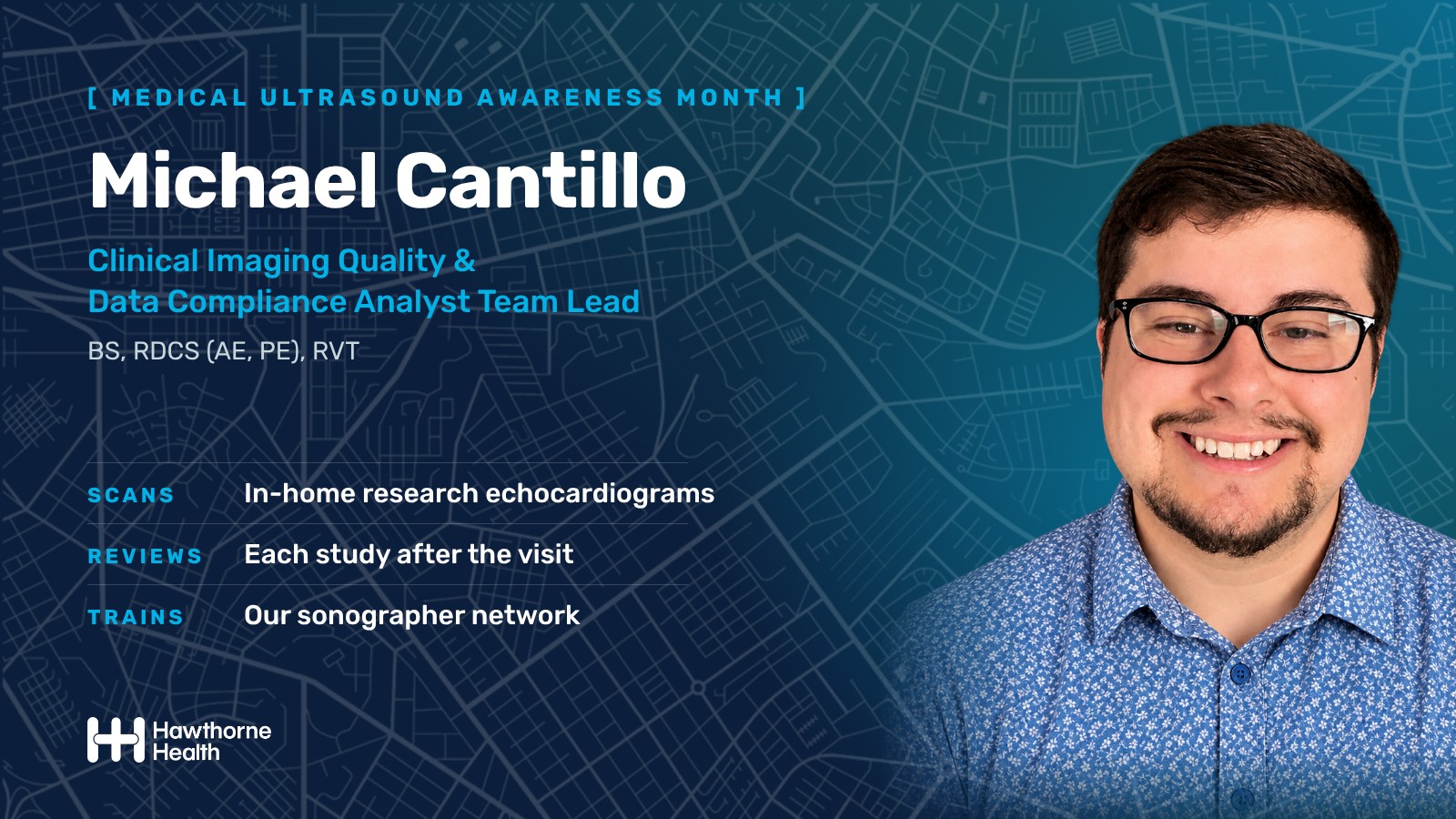
In conversation with Michael Cantillo, BS, RDCS (AE, PE), RVT
Clinical Imaging Quality & Data Compliance Analyst Team Lead, Hawthorne Health
In PREVUE-VALVE, published in JACC in 2026, Hawthorne Health sonographers completed 3,002 comprehensive echocardiograms in participants' homes across all 50 states. Images were acquired to the core laboratory's full protocol and read independently, and 99.9% produced an interpretable study.
Results like that come down to the people holding the transducer, and to the people checking their work. Michael has done both. He started out performing in-home research echocardiograms, moved into imaging quality and data compliance, and now leads the team that reviews each study after the visit, along with onboarding, training and mentoring for our sonographers.
What does a normal in-home echo visit look like?
Every visit starts before I arrive. I review the study protocol, confirm I have the equipment and supplies I need, and make sure I understand the imaging requirements for that visit. I also connect with the patient or their caregiver to confirm the time, location and expectations.
When I arrive, I introduce myself, explain my role and walk the patient through what to expect. One thing I really enjoy about in-home echocardiography is meeting patients in an environment where they're generally more comfortable. Then I find an appropriate space, set up my ultrasound equipment, and position the patient as comfortably as possible while still obtaining the images the protocol requires.
The exam itself is very similar to what you'd expect in an echo lab, but you have to be more adaptable. You're working with the space, lighting, furniture and positioning options you have. When I'm done, I review my images to make sure the protocol requirements are met, clean and pack my equipment, and make sure the patient is comfortable before I leave. Then the study data is documented and submitted according to the study's requirements.
A living room isn't an echo lab. What does it take to get protocol-quality images there?
The biggest difference is that you don't have a controlled environment. In a lab you may have an adjustable exam table, appropriate lighting and equipment positioned for cardiac imaging. In someone's home you may be working around a couch, a recliner or a bed that wasn't designed for ultrasound.
You really have to understand your scanning techniques and be willing to adapt. Adjusting your transducer position, changing your scanning angle or repositioning the patient can make a significant difference in image quality.
One thing I always emphasize when teaching sonographers is that understanding why you're obtaining an image is just as important as knowing how to obtain it. Research protocols often have very specific requirements for acquisition, measurements and documentation, so you have to be intentional with every image. The goal isn't just to complete an echocardiogram. It's to obtain accurate, reproducible, diagnostic-quality images that satisfy the research protocol, whatever the setting.
You've done the visits and reviewed the data afterward. What are you looking for when a study comes in?
Having experience on both sides has given me a much greater appreciation for consistency and attention to detail in research imaging.
When I review a study, I'm evaluating more than whether the images look good. I'm checking whether the required views were obtained, whether the images are properly optimized, whether measurements and Doppler acquisitions are accurate, and whether the study meets the specific requirements in the protocol. I'm also looking for inconsistencies that could affect the reliability of the research data. Something that seems minor during acquisition can become much more significant once that information is used for research.
Seeing the quality and data compliance side has changed how I scan. I'm more intentional about acquisition and documentation, and about making sure another person reviewing my exam can clearly understand what was obtained.
In your new role you'll onboard, train and mentor our sonographers. How do you make a scan in Texas hold up the same way as a scan in Florida?
My biggest focus will be standardization through education, communication and continuous quality improvement.
Across a nationwide network of sonographers, everyone brings different experience, training and scanning habits. That isn't necessarily a bad thing, but in clinical research consistency is extremely important. I want our sonographers to understand not only what each protocol requires, but why those requirements matter.
My approach to education has always been to make information approachable and applicable to real-world scanning. I believe in constructive feedback, good and bad, and in coaching before corrective action whenever possible. If someone is struggling with a particular view, measurement or protocol requirement, I want to understand why and help them improve. I want sonographers to feel comfortable asking questions, receiving feedback and continuing to develop, no matter what stage of their career they're in.
Whether a study is performed in Texas, Florida or anywhere else, the expectation should be the same: consistent, high-quality imaging that meets the protocol and produces reliable research data.
What do patients tell you about having their echo done at home?
The thing I hear most often is how convenient it is. For some patients, traveling to a healthcare facility can be physically exhausting or logistically challenging. Others simply appreciate not having to arrange transportation, navigate a large medical facility or spend time in waiting rooms.
Patients are often more relaxed in their own environment, and more comfortable asking questions or talking about their experiences. It reminds you that healthcare isn't just about the exam you're performing. It's also about the patient's experience. Being able to provide a diagnostic cardiac exam while minimizing the disruption to someone's day is incredibly rewarding.
What surprised you once you got into in-home research echo?
How much goes into coordinating clinical research imaging outside a traditional healthcare facility. I knew echocardiography in hospitals and outpatient settings, but I hadn't really considered the role mobile cardiac sonographers could play in clinical research. Once I was involved, I realized how important this model can be for making research participation more accessible.
I was also surprised by the level of detail required to maintain imaging quality and protocol compliance across many locations. All sonographers pay attention to detail, but in clinical research one study can have very different expectations from another. It opened my eyes to a different side of cardiovascular sonography, and showed me our profession has opportunities beyond the hospital or outpatient setting.
Why did you choose Hawthorne Health, and what's kept you here?
Initially, it was the chance to apply my echocardiography skills in a setting completely different from what I was used to. I've always enjoyed opportunities that let me grow professionally, whether that's through clinical research, education or professional involvement.
I started out performing in-home research echocardiograms, and that experience opened the door to imaging quality and data compliance. Now I'm stepping into a leadership role: leading the post-visit data management team, and onboarding and mentoring our sonographer network. It brings together several areas of my career I'm passionate about. I can contribute not only as a sonographer, but as an educator and someone helping to improve the quality and consistency of our work.
What's kept me here is undoubtedly the team. We have a fantastic team.
What would you tell another sonographer who's thinking about research or in-home work?
I'd absolutely encourage them to explore it. There are so many opportunities within sonography that we aren't always exposed to during our initial education or clinical training, and clinical research is one of them.
Research challenges you to think differently about image acquisition, protocol adherence, documentation and reproducibility. In-home imaging also takes a level of independence, adaptability and problem-solving that can really help you grow as a sonographer. Keep developing your technical skills and stay open to learning. Something many sonographers don't know is that you don't necessarily have to leave your clinical position to start exploring research.
Most importantly, don't underestimate the value sonographers bring to clinical research. We're not simply acquiring images. We're helping generate the data researchers rely on to evaluate treatments and advance patient care.
Anything else people should know?
Sonographers contribute far beyond image acquisition, and that's what Medical Ultrasound Awareness Month is all about. Every day, sonographers play an important role in patient care, research data integrity, quality assurance and the success of clinical studies.
As someone passionate about sonography education, I believe we have a responsibility to keep investing in our profession: supporting newer sonographers, sharing knowledge, encouraging professional involvement and creating opportunities for continued learning. I'm particularly excited about helping build the educational side of our imaging quality team, so our sonographers feel supported, confident and equipped to do their best work.
At the end of the day, quality imaging starts with well-trained, supported sonographers. Investing in their development benefits our research partners, our organization and, ultimately, the patients taking part in these studies.
Read the PREVUE-VALVE and REMS program case studies at hawthornehealth.com/case-studies. Sonographers interested in research work can see open roles at hawthornehealth.com/careers.